Need Help?

Beyond continuously strengthening relationships with stakeholders and creating long-term value for them, we also engage through diverse communication channels to gain a deeper understanding of their needs and expectations. This allows us to identify key issues requiring the Group's focus, and take proactive steps to collaborate with stakeholders in advancing sustainable development.
In response to the expectations of our stakeholders, we closely monitor evolving social, economic, and environmental landscapes, and regularly review opportunities and risks associated with sustainable development. Through the Board ESG Committee, the Group regularly reports material ESG concerns and risks to the highest governance body (the Board), in order to ensure that ESG factors are fully incorporated in its operational strategies and critical decisions. This year, we continued to adopt the double materiality assessment framework, while adjusting certain assessment methods and processes based on the Group’s operational development and governance needs. This enabled us to focus more on the most material issues and strengthen their connection to actual operations and financial performance. The process of the double materiality assessment this year is as follows:
1. Identification of Material Issues
| 2. Stakeholder Communication
|
3. Double Materiality Assessment
| 4. Response to Material Issues
|
The "Double Materiality Matrix" displays the relative ranking of 24 material issues based on their impact on enterprise value (X-axis) and their impact on the economy, society, and the environment (Y-axis). Among these, 12 core issues were identified as the most material issues.
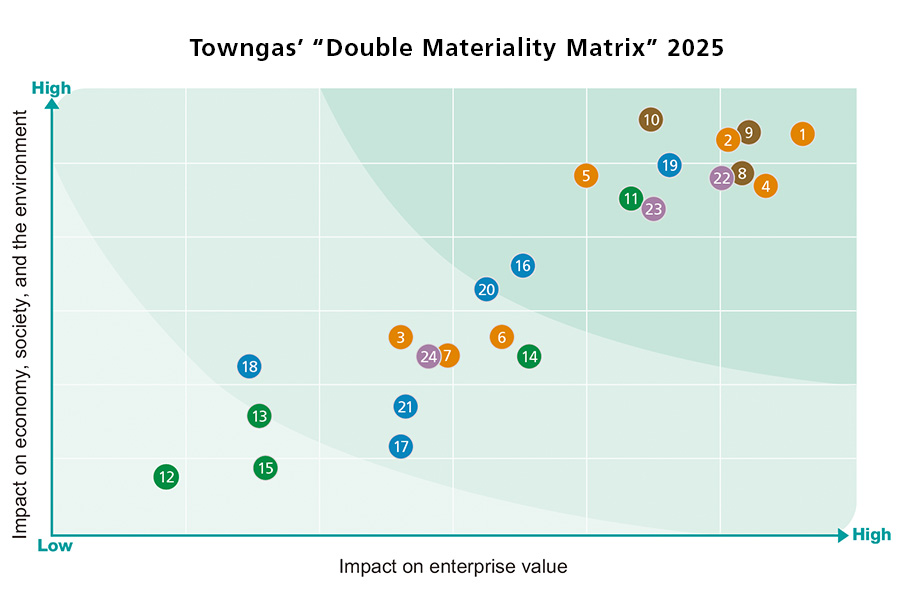
1
Supply Security and Reliable Production and Distribution*
2
Asset Integrity and Crisis Management*
3
Corporate Governance
4
Business Integrity and Compliance*
5
Data Privacy and Cyber Security*
6
Economic Impact
7
Innovation
8
Climate Adaptation and Resilience*
9
Low-Carbon Business Opportunities and Investment*
10
Greenhouse Gas Emissions*
11
Energy Efficiency*
12
Water and Wastewater
13
Waste Management
14
Nature and Biodiversity
15
Air Emissions
16
Employee Engagement and Development*
17
Human Rights Management
18
Inclusion and Diversity
19
Occupational Health, Safety and Well-Being*
20
Customer Health and Safety
21
Community Contribution
22
Energy Affordability and Accessibility*
23
Customer Experience*
24
Responsible Supply Chain Management
* Indicates most material issues.