Need Help?

The Group is committed to protecting our employees, contractors, customers and the general public against health and safety risks. This commitment and our safety management approach are clearly outlined in our Health and Safety Policy. A Group Health, Safety and Environment (HSE) Management Manual is in place to outline the framework of the HSE management system, with standard operating procedures and detailed guidelines. These documents are regularly reviewed and updated to ensure our practices comply with the government regulations as well as the latest industry standards.
Chaired by the Managing Director, the Group HSE Committee comprises the Chief Operating Officer of each Business Segment and the person-in-charge of the Group's safety and environment to oversee HSE issues. The variable compensation of the Managing Director and senior executives is linked to ESG material issues (including health and safety) in order to enhance accountability beyond shareholders and drive performance improvement.
Under the Group HSE Committee, each Business Segment formulates a HSE Committee to monitor HSE performance and provide two-way communication about health and safety issues for safety governance. Different levels of employees (from managerial to general) and contractors are invited to participate in the regular meetings of these committees to ensure accurate and timely communication of the Group's HSE information. Simultaneously, we oversee and guide business regions and project companies in safety risk identification and assessment, ensuring the effective operation of the safety risk management system.
On the Chinese mainland, the Group has established an internal Safety Responsibility System and set up key performance indicators (KPIs) for our project companies, including third-party damage rate, regular safety inspection rate, incident rate, etc. These KPIs are closely monitored and reported to the Group HSE Committees. The general managers of utility business project companies conduct a safety inspection every month to identify potential hazards and address any issues that may arise. Safety and risk management audits of our mainland project companies are conducted once every two years, while process safety management (PSM) audits for our chemical plants in full operation are conducted annually.
The Group prioritises community safety by conducting regular safety inspections for customers to ensure the reliability of gas systems, and we remain committed to providing quality products and services, strengthening the protection of public safety for the community.
To ensure our products and services meet the strictest safety requirements, the Group has formulated a rigorous set of internal operational guidelines, requiring all employees to strictly implement the guidelines and comply with all laws and regulations. These guidelines cover the installation, replacement and maintenance of gas appliances and gas meters as well as gas pipes and fittings.
Product Safety Design
Product User Guide
Customer Service
|
On top of the commitment to fully comply with all applicable health and safety laws and other requirements, the Group targets "zero incidents" and has set internal targets for continuous improvement. We also strive to prevent ill health and injuries related to psychosocial risks, and to promote well-being at work. This goal is supported by an Occupational Safety and Health (OSH) management system, which is established in accordance with international standards such as ISO 45001 and covers the work scope of all employees and contractors. The safety standards of workplaces under the Group are the same for both employees and contractors. Both the operational effectiveness and performance of the health and safety management system are evaluated and assessed through inspections and audits (either internal or external).
In Hong Kong, we actively participate in the International Safe Workplace Programme (ISWP) to provide safety and health protection for our staff.
Hazard Identification, Risk Management and Incident InvestigationThe Group’s OSH management system includes a comprehensive risk and opportunity management mechanism to identify work-related hazards including high-consequence injuries and occupational diseases. Through risk analysis and evaluation, such as Job Hazard Analysis (JHA), we apply the hierarchy of controls to drive continual improvement, minimise risks and ultimately eliminate hazards. To ensure the quality of the processes for identifying and assessing work-related hazards, training on the application of these tools is provided to relevant personnel regularly, and the Group also checks and verifies the competence and experience of personnel who conduct such processes. If our workers consider that they are exposed to an imminent and serious danger to their life or health, they have the right to evacuate the dangerous workplace immediately, and will not be subject to any disciplinary action. We continuously monitor potential hazards in the workplace, establish mitigation measures, and drive ongoing improvements in safety performance. Work-related incident investigation policies and processes are in place. In the event of an incident, we will conduct an investigation and submit a comprehensive report providing the root causes, recommendations and corrective actions for the concerned department's reference. The goal is to determine the cause and identify ways to prevent its recurrence. Additionally, to safeguard workers' health and safety, the Group provides medical and healthcare services to address their work-related injury and other health issues. Contractor Safety ManagementContractors are issued with our Contractor Safety Handbook before commencing work, so they are aware of the standards we expect with regard to health and safety. In the case of contractors' poor performance, intervention for management improvements will be conducted by Towngas to improve contractors' safety performance. Before a new project begins, we provide contractors with safety and health information and the emergency handling procedures they should follow.
|
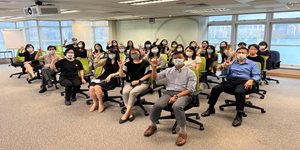
To help our employees and contractors deepen their understanding of our safety culture, we organise training courses, workshops and activities. A Towngas HSE and Caring Programme is also in place to provide mentorship and HSE training for new joiners. Additionally, we provide health and safety briefings to employees operating in various roles. Examples include safety for work at height and in confined spaces, as well as excavation work close to our gas pipelines.
Various reporting channels and promotion schemes, such as HSE Suggestion and Near Miss Reporting Platform, have been set up to encourage employees and contractors to report work-related hazards and near-miss cases for rectification and improvement. To encourage reporting, we reward employees and contractors who flag cases and provide incentive schemes to those demonstrating responsibility, awareness and a high level of safety performance.
In addition, the Group actively engages with communities and schools by regularly conducting safety promotion and inspection initiatives. Through a wide range of communication channels, including customer surveys and focus groups, Customer Focus Team visits, safety exhibitions and talks, leaflets, videos, posters and the websites, we communicate health and safety information and promote greater safety awareness among stakeholders.
The Group connects with stakeholders to enhance their safety awareness and build trust. We also work closely with the government authorities to formulate strategic plans, such as a facilities utilisation framework and preventive maintenance index, to ensure optimal safety.
In order to maintain the highest safety standard not just within the Group but across the industry, we share our safety experience and standards with corporations, contractors and professional organisations.
On the Chinese mainland, we have taken part in the compilation and revision of relevant national and industry standards and guidelines. We have also shared our experience to promote the high-quality development of the gas industry on the Chinese mainland.